
Pike County Most Wanted Status
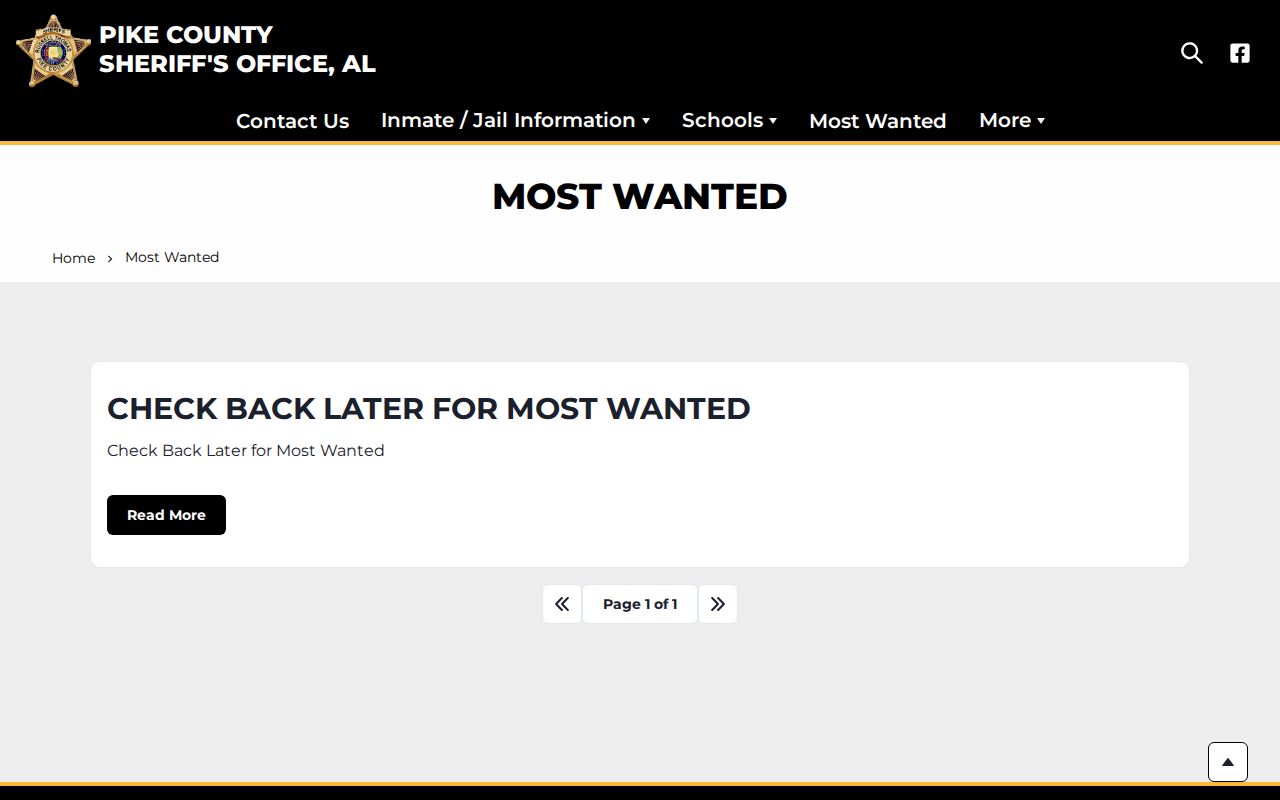
The Pike County Sheriff’s Office Most Wanted page is the official starting point. When the source was checked, it held one site message that said to check back later. It contained no named wanted person, alleged offense, physical description, caution flag, or wanted-person photo. The count of actual profiles was therefore zero. The sheriff did not state an update schedule, an archive policy, or a standard set of fields for future profiles.
That result must be read narrowly. It shows that the public page had no profile at that time. It does not show that Pike County had no active arrest warrants, bench warrants, or other process. A sheriff may publish selected high-priority cases while many orders stay in court and law-enforcement systems. Likewise, removal from a public page does not reveal whether a person was arrested, a warrant was recalled, or the agency simply changed what it chose to display.
The official Pike County Most Wanted source can be seen in the captured interface below. The image documents the empty state without copying or hosting a wanted person’s photograph.
The placeholder makes direct verification more important. Recheck the live sheriff page because its content may change after the capture date.
Pike County Wanted Listing Fields
The current page provides no person-level fields to inventory. Inventing a sample profile would give a false view of what the sheriff publishes. The table separates what was actually present from common details that were absent. If profiles appear later, read only the fields shown on that live official notice and note its posting date.
| Field | What the official page showed |
|---|---|
| Status message | A request to check back later |
| Name or alias | No person listed |
| Photograph | No wanted-person photograph displayed |
| Warrant or charge | No offense, case number, or warrant basis displayed |
| Description or location | No physical description or last-known-area field displayed |
| Posting history | No update date, cadence, or archive stated |
A future profile should still be treated as a dated agency notice. Match the name, agency, and any case or warrant number before drawing a link to another record. Common names can point to the wrong person. If the sheriff later posts a photo, view it there; do not copy, repost, or use the face alone as identification.
After an arrest, the person may enter Pike County Jail and generate a booking record. The county’s busted mugshots and booking-record hub explains how current custody, release, and a later court case differ. Absence from its public roster also cannot clear a warrant because Pike’s roster has been a blank placeholder.
Note: A blank public wanted page reports publication status, not the full status of process held by courts or law enforcement.
Read Pike County Wanted Notices
Use a live official notice as a lead, then keep the response safe and exact. The point is to send useful facts to the agency, not to investigate or confront someone. A page capture may be stale within hours, while a name or photo can be misread. Start again at the live sheriff route each time.
- Open the official Pike County Most Wanted page and confirm that an actual person profile is present.
- Read the agency name, posting text, alleged basis, and any case or warrant number exactly as shown.
- Check the posting date and compare identifying details. Do not rely on a face, nickname, or social repost alone.
- If the information is not urgent, use the sheriff’s official tip form. For a crime in progress or immediate threat, call 911.
- Do not approach, follow, detain, threaten, or publish a private address. Let law enforcement assess and act.
The sheriff’s page does not publish a verified “Warrant Wednesday” series or a county reward plan. Social posts can be useful for time-sensitive agency notices, but they do not form a full warrant ledger. Save the official link and date if a notice is later discussed with the sheriff or clerk.
Check Pike County Warrants
No official public Pike County name-search warrant portal was found. The Most Wanted page is not that portal, and a zero-profile result is not a “no warrant” result. The safe check route depends on the agency and court that issued or received the process. The Pike County Sheriff handles law-enforcement status, while a clerk can address the public court file connected to its court.
- Gather the full legal name, date of birth if lawfully known, and any case number. Avoid broad name-only conclusions.
- Call the Pike County Sheriff’s Office at 334-566-4347 and ask which office can address the operational warrant question.
- Contact the Pike County Circuit Clerk at 334-566-4622 for the related public state-court file or clerk routing.
- If a municipal case may be involved, ask the relevant municipal court. The circuit clerk does not control every city matter.
- If the warrant may concern the caller, consult a lawyer and arrange a lawful court or surrender response. Do not rely on a third-party list.
A clerk record may show that a judge issued an order in a case. The sheriff determines the operational status held by law enforcement. Timing also matters. A recalled or served order may not appear the same way in every system at once, so record the office, date, and exact answer instead of treating an old web result as clearance.
Safety: Do not use a warrant check to avoid service or help someone flee. Use counsel, the issuing court, and law enforcement to resolve it.
Pike County Warrant Types
The type of order helps identify the right court and the safest next step. These terms describe broad legal functions, not the status of a specific Pike County case. Only the issuing record and authorized office can confirm whether an order remains active.
| Type | Plain-language meaning | Safe verification route |
|---|---|---|
| Arrest warrant | A judge authorizes arrest based on a sworn legal showing. | Issuing court record, then sheriff or responsible agency |
| Bench warrant | A court directs arrest after a failure to appear or comply with a court order. | Clerk for the case file, then counsel and the issuing court |
| Failure-to-appear process | Court action tied to a missed required appearance. | The court named in the case, not a media or booking page |
| Other agency process | An order may arise outside Pike County or under another jurisdiction. | The issuing jurisdiction and the agency that holds it |
A warrant is not a conviction. It can precede a hearing where identity, bond, counsel, and the allegation are addressed. “Bench” does not mean minor, and “arrest warrant” does not reveal the final charge or result. The later docket may show dismissal, amendment, plea, trial, or another disposition. Read the final order rather than assuming the outcome from the warrant label.
Note: Third-party arrest pages and social posts cannot provide definitive warrant clearance, even when they show a recent Pike County entry.
Send Pike County Wanted Tips
Want to pass along something useful about a Pike County wanted notice? The sheriff's office keeps an official Submit a Tip form for exactly that. The contact fields are optional, so you can fill in as much or as little as you like. Just know what the form does and doesn't promise. The agency makes no express pledge of anonymity, and no reward schedule appears anywhere on it. Unless the sheriff's office confirms those terms for a specific matter, don't assume either one applies to your tip.
Pike County Sheriff’s Office
1318 North Three Notch Street
Troy, AL 36081
334-566-4347
Official online tip form for non-emergency information
Pike County Circuit Clerk
Pike County court-record routing
334-566-4622
Use for the public case file, not emergency reports
The form warns that it is not for a crime in progress. Call 911 for an active emergency. A useful tip states what was seen, where, when, and why the observer believes it connects to the official notice. Avoid guesses about guilt or motive. Never send threats, try to hold someone, or share a private location publicly.
Troy Police separately publishes 334-215-STOP for city crime tips. That city number should not be presented as the Pike County sheriff’s warrant line or as a county Crime Stoppers reward program. Route a tip to the agency named in the notice whenever possible.
Pike County Sheriff App Alerts
Pike County’s current OCV app, “Pike County Sheriff’s Office (AL),” offers agency news, tips, public-safety interactions, and jail-information navigation. Use the official sheriff app landing page rather than an older package found in search results. Its current identifiers are Apple app ID 6739783195 and Android package com.ocv.a1348.
The official Pike County sheriff app source is shown below. It is a useful agency channel, but it shares the site’s OCV content backend and should not be treated as a hidden wanted-photo or warrant database.
Because the sheriff’s wanted and roster content were placeholders during research, installing the app does not guarantee more profiles or photographs. Confirm any alert category and cadence inside the current app.
The sheriff also links an official Facebook page. Posts and press releases are selective and event-driven. They may move faster than a static page, yet neither is an archive of every warrant.
Resolve Pike County Warrants Safely
A person who thinks a Pike County warrant concerns them should avoid guesses based on a blank list. Counsel can identify the court, review the case, and help arrange a lawful response. The issuing court can address its orders and hearing process. The sheriff can route law-enforcement status questions. None of those offices should be asked for a promise based on an unofficial page.
Keep a clear record of the full name searched, case number, court, date, office contacted, and answer received. If a court docket later shows a disposition, read the actual order. “Disposed” is a case-status term, not a synonym for convicted. A warrant may be served or recalled while the underlying allegation continues, and an arrest can still end in dismissal, acquittal, amendment, plea, or adjudication.
Safety is the fixed rule. Tips go to law enforcement. Personal warrant questions go through counsel, court, and the responsible agency. No one should approach a person because of a photo or name match, and no public list should be used to declare guilt.